On behalf of the Nominating Committee, I’m pleased to share the slate of candidates for the 2026 board election. Every active member organisation is invited to submit a ballot to elect the incoming board class.
We’re providing a summary of the board’s July 2026 meeting. The July board meeting is our only in-person meeting. The board gathers for two days of strategic thinking and long-range planning, as well as conducting annual board business. This year, we focused on allocating surplus funds we have on hand to invest in a three-year project to redesign the content system. In a related discussion, we decided to lower content registration fees starting in 2027 because we’ve had a demonstrated history of generating surpluses, exceeding what we need to run Crossref. We also discussed the board structure, as part of our regular review of stakeholder governance. And we conducted annual board business, such as approving the audited financial statements and reviewed our risk register and mitigation plans.
The resolutions are available on the dedicated section of our website, which also lists the members of the Board and offers further information about our governance.
We also managed to squeeze in watching a World Cup game over dinner.
Starting today, funder names deposited in Crossref metadata without an identifier will be matched to ROR IDs, to support an open and connected Research Nexus. Funding information is an increasingly important part of the scholarly record. The improved matching strategy supports researchers, funders, institutions, and meta-researchers, who rely on that information to understand how research is supported and what outcomes that support produces.
Strengthening Scholarly Publishing in Africa is a collaborative webinar series bringing together ASSAf, Crossref, DOAJ, EIFL, and PKP to share practical guidance, resources, and approaches for strengthening the publishing ecosystem in the region. This series responds to the growing interest in open access, digital publishing, stronger editorial practices, and greater visibility of research publishing across Africa. Each partner organisation has long experience of building that capacity in the area of their expertise. In this series, we’re coming together to offer a more holistic learning experience to the community of African publishers, putting different aspects of the publishing process in their broader context.
Pending publication is a way of creating a DOI and depositing metadata for a content item any time after a manuscript has been accepted but before it is published online. This is possible for all standard record types (such as articles, books, conference proceedings).
Because a pending publication has not yet been published, its DOI will resolve to a publicly-available Crossref-hosted landing page. Once the work is published online, this same DOI will resolve to the URL for that content.
The pending publication record type serves as a temporary placeholder for your content - like a “coming soon” or preview of the great work to come. For a pending publication, you register basic metadata for your content item before registering all the formal metadata that comes with a version of record. Take care not to share a DOI before it has been deposited with us, or it will not resolve for your readers, and will lead to a failed resolution in your resolution report. Learn more about the pending publication consultation.
Use cases for pending publication
Before the pending publication record type existed, we recommended you to register DOIs at the time content was published online, or shortly after. As the communication needs of our members (researchers, funders, institutions, and publishers) evolve, we have created this new solution to aid you and your work, and allow you to register DOIs before content is published online. With pending publication:
Members can:
address timing issues related to press embargos
publicly establish scholarly precedence for their articles
meet the conditions in full for new funder policies and mandates, which focus on acceptance as a key event to report on
ensure that institutional repositories use the DOI to link to the member-stewarded copy
Researchers can provide formal evidence of all publications in employment and grant applications
Funders can fully track all publications funded by their research grants
Institutions can fully track the scholarly output of their faculty members
Technology vendors that support scholarly research management can account for all outputs
How does pending publication work?
When registering your publication as pending there are two things you need to do:
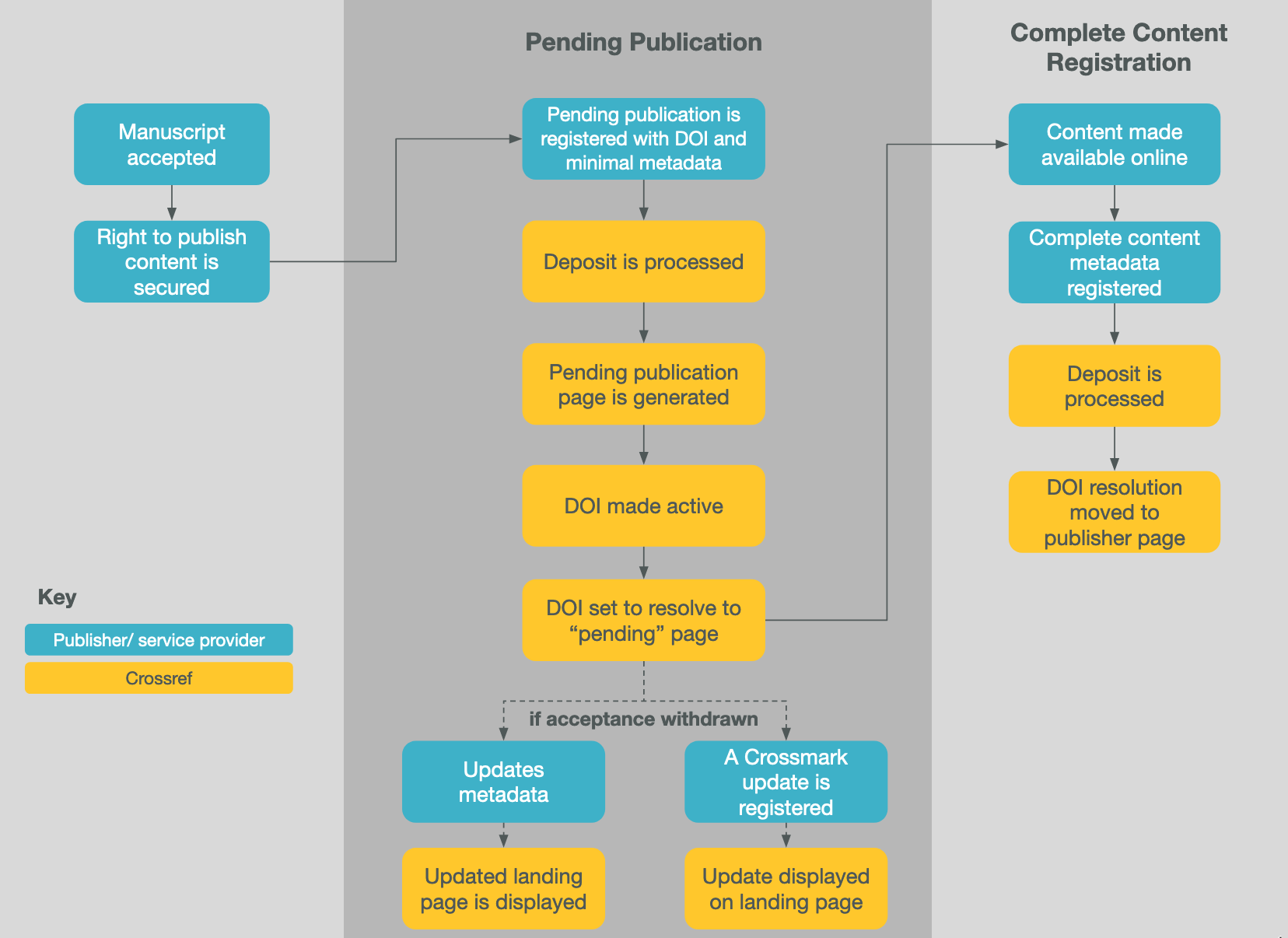
Register a subset of the metadata (as a minimum: member name, journal title, and accepted date) under the Pending Publication record type.
After you do this, the DOI will resolve to a Crossref-hosted landing page displaying your logo, a banner showing the manuscript has been accepted for publication, and the metadata you’ve provided. As with all registered content, pending publication metadata will be publicly available in our XML API (and updated as you update your metadata records). Unfortunately, we do not yet support pending publications in our REST API.
Once your work is published, you need to register the full metadata for the work - this is not an automatic process. You must update the metadata for each pending publication DOI, so that each DOI will resolve directly to the content (and not the pending publication landing page).
Pending publication workflow diagram
Crossmark participants please note that you can deposit Crossmark metadata at any point, but during the Beta version of the pending publication rollout, the Crossmark badge will not be displayed to readers.
Fees for pending publications
Content Registration (metadata deposit) fees still apply, but there are no additional fees for using pending publication. So, you’ll be charged once when you register the pending publication, but any subsequent updates, including the update on publication, are not charged.
History
Pending publication has been supported since 2019 and was designed in response to community feedback: