A couple of months ago, Ludo Waltman and André Brasil raised some questions about good practices for Crossref DOI registration, asking for input from the scholarly communication community. In this post, Ludo and André reflect on the input received and discuss the approach to DOI registration that the MetaROR publish-review-curate platform is going to take.
As Crossref celebrated its 25th anniversary last year, we are highlighting some of the most active and engaged regions in our global community.
Over the past 25 years, the makeup of Crossref membership has evolved significantly; founded by a handful of large publishers, we now have more than 24,000 members representing 165 countries. Nearly two-thirds of them self-identify as universities, libraries, government agencies, foundations, scholar publishers, and research institutions.
It’s been said that Americans are unusual in tending to ask “Where do you work?” as an initial question upon introduction to a new acquaintance, indicating a perhaps unhealthy preoccupation with work as identity. But in the context of published research, “What is this author’s affiliation?” is a question of global importance that goes beyond just wanting to know the name – and perhaps prestige level – of the place a researcher works.
As Crossref membership continues to grow, finding ways to help organisations participate is an important part of our mission. Although Crossref membership is open to all organisations that produce scholarly and professional materials, cost and technical challenges can be barriers to joining for many.
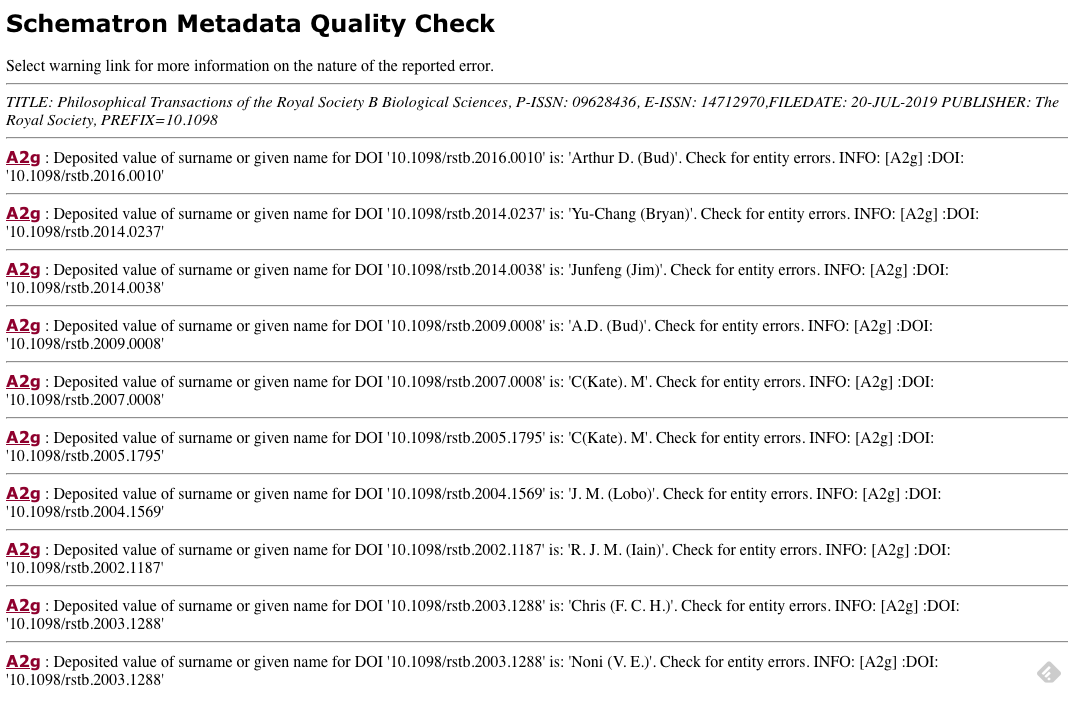
A Schematron report tells you if there’s a metadata quality issue with your records.
Schematron is a pattern-based XML validation language. We try to stop the deposit of metadata with obvious issues, but we can’t catch everything because publication practices are so varied. For example, most family names in our database that end with jr are the result of a publisher including a suffix (Jr) in a family name, but there are of course surnames ending with ‘jr’.
We do a weekly post-registration metadata quality check on all journal, book, and conference proceedings submissions, and record the results in the schematron report. If we spot a problem we’ll alert your technical contact via email. Any identified errors may affect overall metadata quality and negatively affect queries for your content. Errors are aggregated and sent out weekly via email in the schematron report.
What should I do with my schematron report?
The report contains links (organized by title) to .xml files containing error details. The XML files can be downloaded and processed programmatically, or viewed in a web browser: