On behalf of the Nominating Committee, I’m pleased to share the slate of candidates for the 2026 board election. Every active member organisation is invited to submit a ballot to elect the incoming board class.
We’re providing a summary of the board’s July 2026 meeting. The July board meeting is our only in-person meeting. The board gathers for two days of strategic thinking and long-range planning, as well as conducting annual board business. This year, we focused on allocating surplus funds we have on hand to invest in a three-year project to redesign the content system. In a related discussion, we decided to lower content registration fees starting in 2027 because we’ve had a demonstrated history of generating surpluses, exceeding what we need to run Crossref. We also discussed the board structure, as part of our regular review of stakeholder governance. And we conducted annual board business, such as approving the audited financial statements and reviewed our risk register and mitigation plans.
The resolutions are available on the dedicated section of our website, which also lists the members of the Board and offers further information about our governance.
We also managed to squeeze in watching a World Cup game over dinner.
Starting today, funder names deposited in Crossref metadata without an identifier will be matched to ROR IDs, to support an open and connected Research Nexus. Funding information is an increasingly important part of the scholarly record. The improved matching strategy supports researchers, funders, institutions, and meta-researchers, who rely on that information to understand how research is supported and what outcomes that support produces.
Strengthening Scholarly Publishing in Africa is a collaborative webinar series bringing together ASSAf, Crossref, DOAJ, EIFL, and PKP to share practical guidance, resources, and approaches for strengthening the publishing ecosystem in the region. This series responds to the growing interest in open access, digital publishing, stronger editorial practices, and greater visibility of research publishing across Africa. Each partner organisation has long experience of building that capacity in the area of their expertise. In this series, we’re coming together to offer a more holistic learning experience to the community of African publishers, putting different aspects of the publishing process in their broader context.
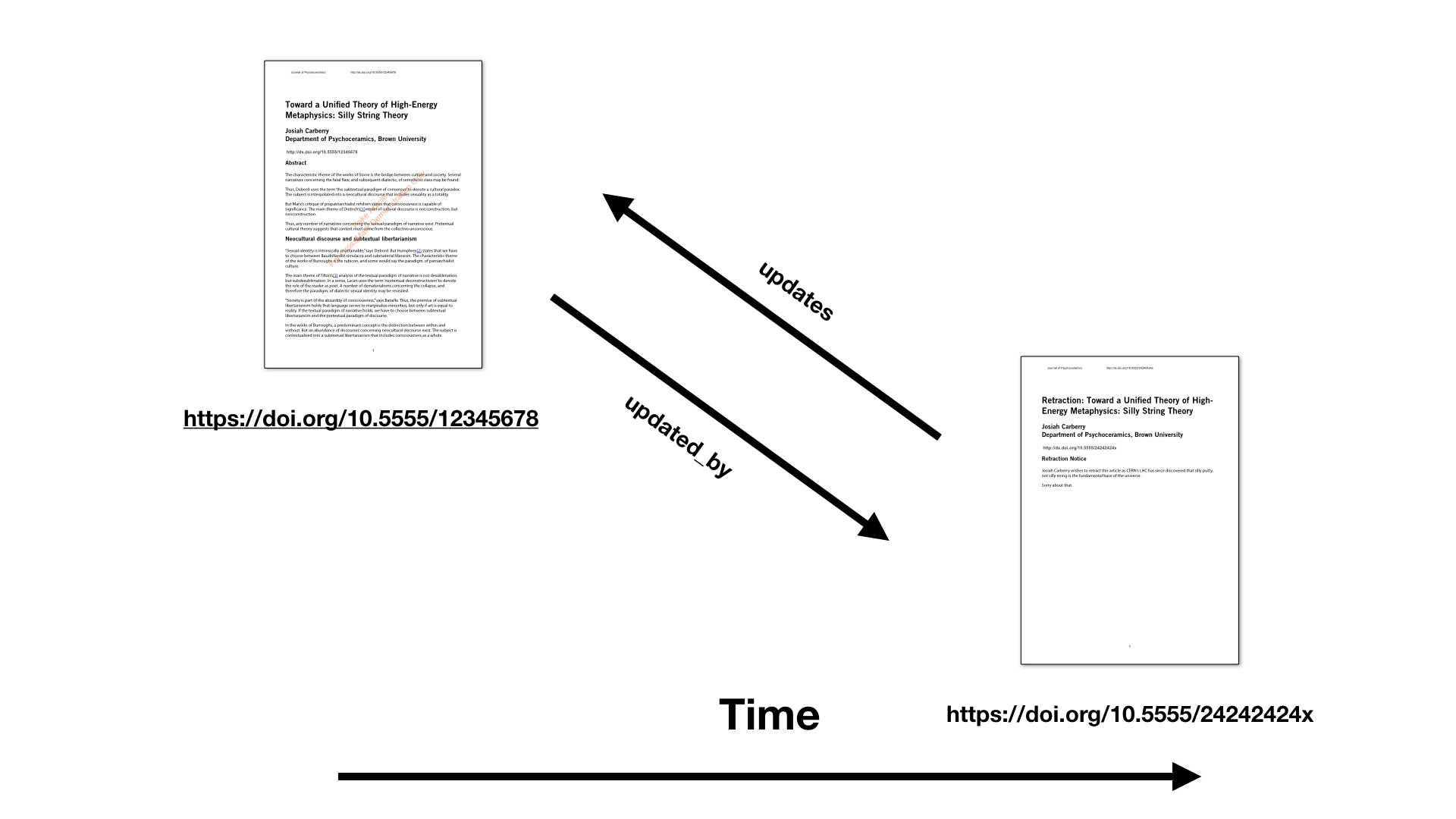
Typically, when an editorially significant update is made to a document, the publisher will not modify the original document, but will instead issue a separate document (such as a correction or retraction notice) which explains the change. This separate document will have a different DOI from the document that it corrects and will therefore have different metadata. This process is complementary to versioning.
In this example, article A (with the DOI 10.5555/12345678) is eventually retracted by a retraction notice RN (with the DOI 10.5555/24242424x). Each document has Crossmark metadata, but the fact that RN updates article A is only recorded in the RN’s Crossmark deposit. The Crossmark internal API has to tie the two documents together and indicate in metadata of the original document (A), that it has been updated_by the second document (RN).
The Crossmark part of the metadata schema is used to register updates, but this doesn’t mean that you need to have implemented other parts of Crossmark to deposit updates. In the examples below, in the <crossmark> section you can use only the <update> field in the deposit XML if you don’t usually deposit other Crossmark metadata.
Example 1: simple retraction
This is a simple example of article A being retracted by a retraction notice RN where both A and RN have Crossmark metadata deposited.
First, the PDF is produced and the XML deposited to Crossref.
This is a simple example of article B being corrected by a correction notice CN where both B and CN have Crossmark metadata deposited. The only real difference between this and the previous example is that we are creating a different kind of update.
When a member does not issue a separate update/correction/retraction notice and instead just makes the change to the document (without changing its DOI either), this is called an in-situ update. In-situ updates or corrections are not recommended because they tend to obscure the scholarly record. How do you tell what the differences are between what you downloaded and the update? How do you differentiate them when citing them (remember, we are only talking about “significant updates” here)? However, some members need to support in-situ updates, and this is how they can be supported.
Example 4: correction of article that has no Crossmark metadata deposited
If you deposit Crossmark metadata for a retraction or and update notice which, in turn, points at an article that does not have Crossmark metadata assigned to it, we will generate a “stub” Crossmark for the item being updated. The stub metadata will simply copy essential Crossmark metadata. This metadata can be queried via our API, but won’t activate anything on your site unless you add the Crossmark widget to the corresponding page of the item being updated.
Example 5: correction notice that corrected multiple documents
Sometimes members issue correction or clarification notices which provide corrections for multiple documents. This too can be supported by Crossmark. In the following example, one correction/clarification document provides updates to two documents (F and G)