Metadata is communication; it can tell a story about research and paint a picture for others to respond to and learn from, across the world and throughout the forthcoming generations. Metadata can feel technical with words like ‘infrastructure’ and ‘schema’, and sometimes, like tech in general, it comes with hyperbole. But metadata really is part art (storytelling and pictures) and part science (structured models and standards) with both aspects being equally important, and requiring people as well as systems. That necessary combination of human and machine involvement also makes metadata challenging.
Once a year we release all metadata records for content registered with Crossref in a public data file. This year’s version, containing nearly 180 million records, is now available. It includes metadata associated with all Crossref-registered DOIs in JSON-lines format.
Crossref Ambassadors act as local points of contact, meeting editors, librarians, researchers, and institutions to help them navigate Crossref services and understand how strong metadata supports visibility, integrity, and trust in research. They explain how to participate in our rich network of connections between works, people, and institutions, in ways that make sense in their own contexts. And last year, being our 25th anniversary, Ambassadors also massively contributed to our celebrations!
We have renewed our partnership with DOAJ to focus on a new set of objectives that reflect both organisations’ commitment to improving sustainable and equitable services and infrastructure. This renewed collaboration focuses on improving the quality of scholarly metadata while expanding support for journals in low- and middle income- countries.
We have worked together since 2021, primarily to encourage the dissemination and use of scholarly research using online technologies, and regional and international networks, partners and communities. This partnership has helped to build local institutional capacity and sustainability within the global scholarly communication ecosystem. A continued partnership also reflects that we have a shared community; currently almost 90% of DOAJ journals are represented in Crossref.
Version control is the management of changes to a document, file, or dataset. Versions of a document may include the following:
Draft
Preprint - early draft or manuscript shared by researcher in a preprint repository or dedicated channel (outside of a specific journal)
Pending publication (PP) - a manuscript which has been accepted but has not yet been published online
Advanced online publication or ahead of print (AOP) - early release of publication which publisher makes available to readers on their platform (prior to typesetting or before final published form)
Author accepted manuscript (AAM) - accepted version which has been peer reviewed but not typeset or copyedited
Version of record (VoR) - typeset, copyedited, and published version
Updated - adding supplementary data or making corrections to the file, or its retraction.
Version control is important for:
traceability (following the development of the document),
identifiability (connecting documents to decisions, contributions, contributors, and time),
clarity (distinguishing between multiple versions of documents, and identifying the latest version),
reduced duplication (removing out-of-date versions), and
reduced errors (clearly indicating to readers which is the current version).
Publication stages and DOIs
How do I decide if I should assign a DOI to a work, and at what stage? This table sets out seven publication stages of a research object (a publication such as a journal article, book, or dataset). A work may not go through all of these seven stages, so you only need to consider the stages relevant to your publication.
Publication stage
Eligible for a DOI?
Which DOI?
1 Draft
No DOI for draft item
n/a
2 Preprint
Yes
DOI A
3 Pending publication (PP)
Yes
DOI B
4 Advanced online publication/ahead of print (AOP)
Yes
DOI B
5 Author accepted manuscript (AAM)
Yes
DOI B
6 Version of record (VoR)
Yes
DOI B
7 Updated
Yes
DOI C
A DOI should not be assigned to a draft (unpublished) work.
A preprint should have its own DOI (DOI A).
Accepted versions (including PP, AOP, AAM, and VoR) should have a separate DOI (DOI B). Establish a relationship between DOI B and DOI A to show the connection between them, such as DOI B “hasPreprint” DOI A.
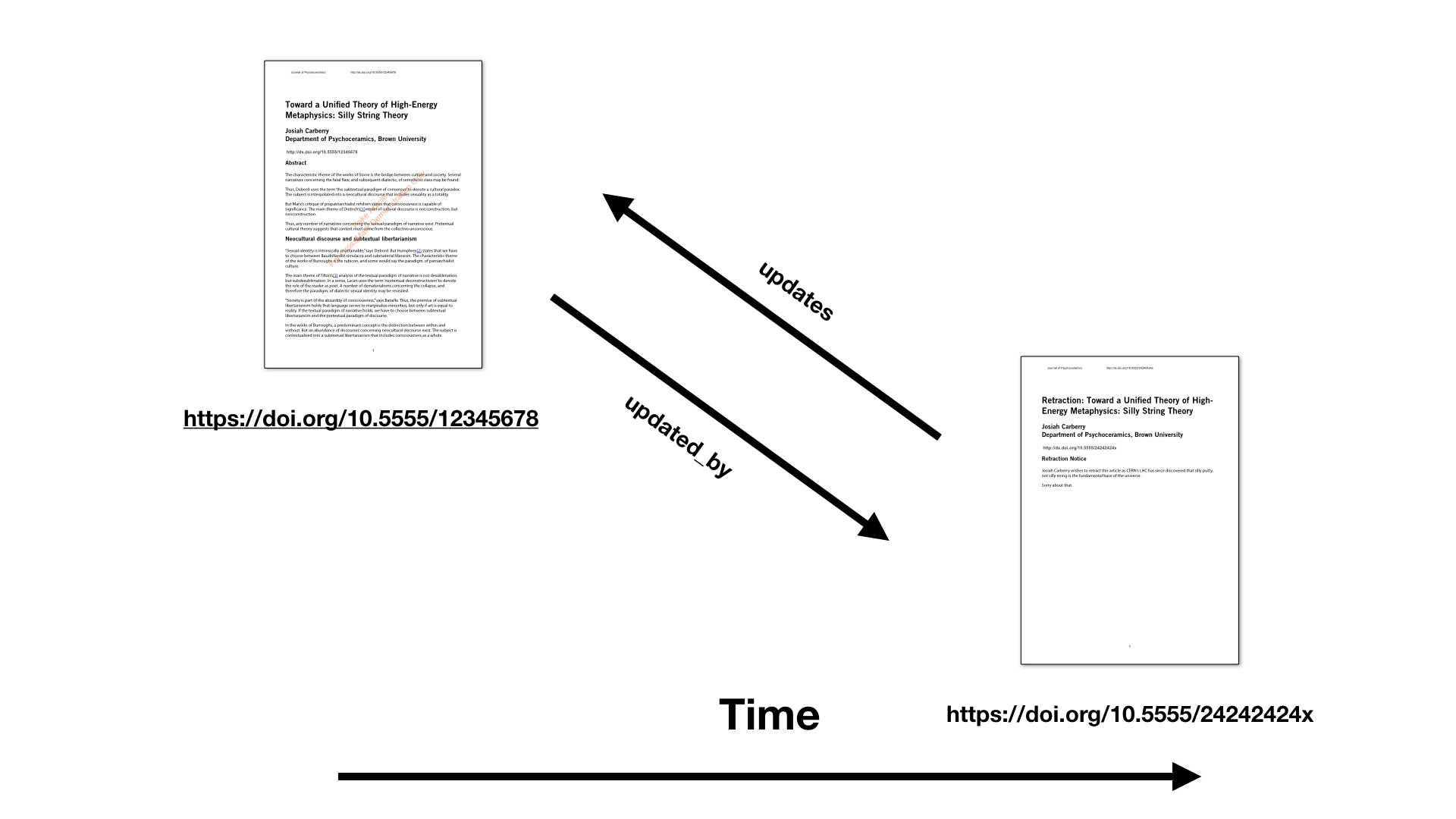
In the case of a significant change to the published version, a notice should be published explaining the correction/update/retraction. The updated version should have a new DOI (DOI C). Updates should only be deposited for changes that are likely to affect the interpretation or crediting of the work (editorially significant changes), and instead of simply asserting a relationship, these should be recorded as updates. See the following section for more information on updates.
Best practices for handling retractions and other post-publication updates
Research can undergo changes after it is published for various reasons. For example, it may be withdrawn, corrected, or retracted. It’s important that these changes are accurately reflected in the scholarly record, so that readers know how to find the most up-to-date work, as well as what research can be relied upon and cited.
When an editorially significant update is made to a document, you should not modify the original document, but instead issue a separate document (such as a correction or retraction notice) which explains the change. This separate document will have a different DOI and different metadata from the document that it updates. This process is complementary to versioning.
The metadata for the update should include a link to the item being updated, as well as information on the type of update, as part of the Crossmark section of the metadata:
A full example of an XML file following best practice can be found here. If you are not comfortable editing XML, you can also register Crossmark metadata using our Web Deposit Form.
Note that you don’t need to use all aspects of Crossmark to register updates. Learn more about the different ways of registering updates in our documentation.
You should also reflect the status of the work in the original DOI’s metadata record by adding “RETRACTED:” in front of the article title. We recommend doing the same for the title listed on the item’s landing page. You may also want to replace the abstract of the work with a retraction statement in both the metadata and on your website or publishing platform.
Finally, if you participate in the Similarity Check service, you should remove the full-text URL from the item’s metadata. To get a retracted work to be removed from the Similarity Check text comparison database, get in touch with Turnitin at tiisupport@turnitin.com.