Each organization in the global community of Crossref members (that’s currently over 24k organizations in 166 different countries) plays a key role in building the Research Nexus. Any opportunity we have to meet with our members in person is a highlight and a way for us to learn more from each other. The month of January saw three of us travel to Bangkok to attend the first-ever Charleston Conference organised in Asia and to meet with our growing community in Thailand.
This year, we placed a spotlight on the Latin American community, hosting the second Crossref Metadata Sprint in São Paulo, Brazil from 4 - 6 March 2026. In our first tri-lingual event, we brought together 31 participants from Argentina, Brazil, Colombia, Ecuador, and Mexico. Our goal was to foster community co-creation using the open scholarly metadata. The Sprint was an opportunity to pose questions, share ideas, collaborate on research, and propose innovative solutions that enhance the use of metadata in scholarly communication and beyond.
Read on for more details about the content of the Sprint, and the resulting projects. You can also register to join our Sprint Showcase call on 22nd April to hear directly from the team about their creations.
On 17 March 2026, we experienced an outage that affected DOI resolution for Crossref DOIs and the deposit of metadata records by Crossref members. In this summary, we outline what happened, the impact on our community, and the steps we are taking to strengthen our systems and processes as a result.
We’re excited to announce a new data citation API endpoint and are seeking your feedback. The new service makes existing data citation relationships in our metadata available, thereby surfacing this part of the research nexus. At the same time, we’ve decided that it’s time to move on from Event Data.
Our LIVE Annual Meeting is back in North America for the first time since 2015, and with just 10 days to go, there’s a lot going on in preparation. As you’d expect with a How good is your metadata? theme—the two-days will be entirely devoted to the subject of metadata—because it touches everything we do, and everything that publishers, hosting platforms, funders, researchers, and librarians do. Oh, and it’s actually super awesome too—and occasionally fun.
Metadata is what is used to describe the story of research: its origin, its contributors, its attention, and its relationships with other objects. The more machines start to do what humans cannot—parse millions of files through multiple views—the more we see what connections are missing, and the more we start to understand the opportunities that better metadata could offer.
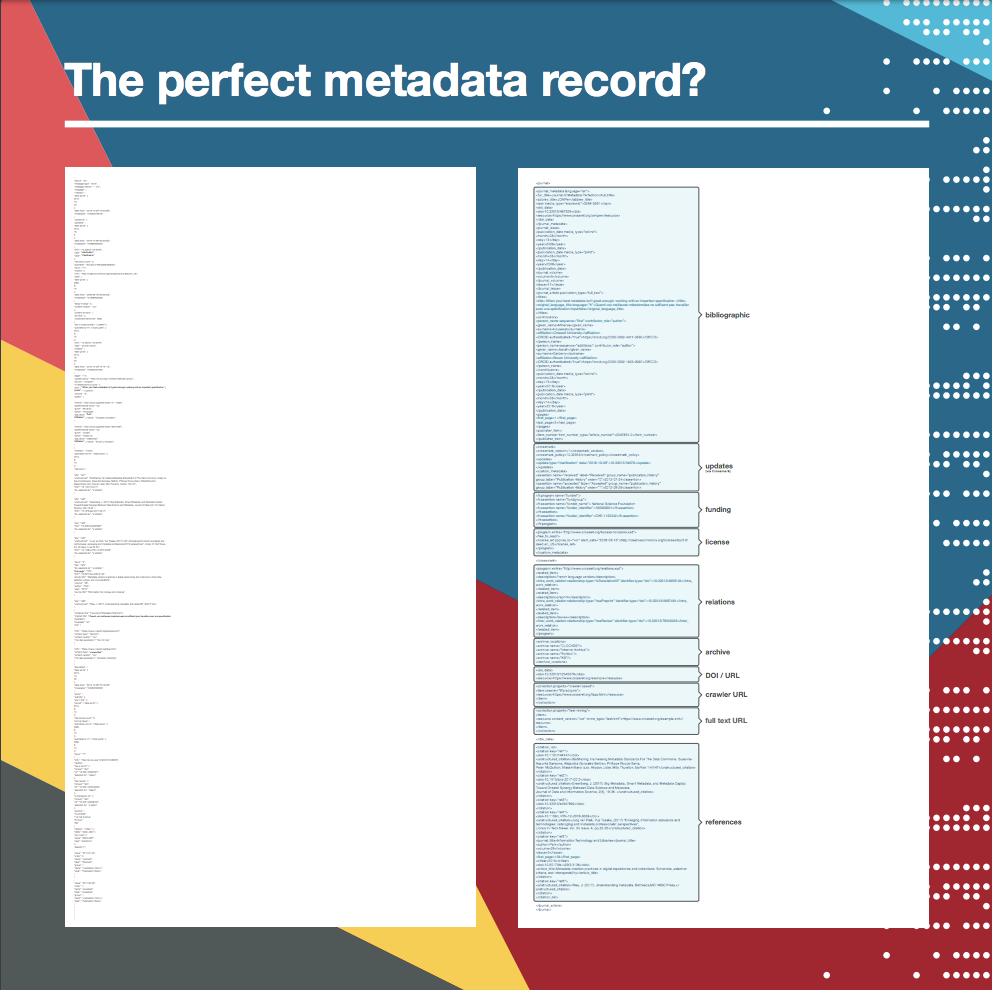
We love metadata so much that we’re producing an 8-foot-high depiction of the ‘perfect’ record, in both XML and JSON, for people to gape at and annotate in person. Sneak preview:
The perfect metadata record is eight feet tall.
SchemaSchemer
Both days feature plenary-style talks, insights from ourselves and guests who will regale us with tales of metadata woes and wonders.
Lisa will be there at the end of Day 1 to update everyone on some recent and potential governance changes, and—the reason we started these gatherings—to reveal the results of our 2018 board election, the second contested election we’ve held, and already with twice the voters from 2017.
Our amazing guest speakers are too brilliant and too experienced to highlight in just one blog. But check out the LIVE18 schedule to see what they’ll be talking about:
Patricia Cruse, DataCite
Ravit David, University of Toronto
Clare Dean, Metadata 2020
Paul Dlug, American Physical Society
Kristen Fisher Ratan, CoKo Foundation
Stefanie Haustein, University of Ottawa
Bianca Kramer, Utrecht University
Graham Nott, Freelance developer (eLife/JATS)
Jodi Schneider, University of Urbana-Champaign
Shelley Stall, American Geophysical Union
We’ll be taking over the entire second floor of the Toronto Reference Library, whose three rooms will house a bunch of conversational sessions as well as some more formal talks:
Rally is the main room where we’ll have the plenary-style talks, a corner for Unscheduled Maintenance offering live support for your questions about billing or tech for Ryan, Shayn, Isaac, Jason, Chuck, & Mike. Running down the whole left side of this room is also the You-are-Crossref wall where the community will showcase their work with metadata through posters - feel free to bring one along and find Patricia to get the sticky tack.
The LIVE Lounge is where you can eat, drink, rest, and chat and where you’ll likely find Rosa as she laises between the caterers, the venue, AV, and all of us. The Lounge is also where we’ll gather for much-needed post-election refreshments at the end of Tuesday.
The Bigger Ambitions Room is where a lot of the Unplugged sessions will take place. This room will feature three separate stations:
R&D & Product where you can chat with Geoffrey, Esha, Jennifer L, Patrick, and Christine about your big ideas for us, and what we’re working on already.
Metadata discussions and annotations of the perfect record (previewed above) with Patricia, together with space to ideate around metadata principles.
Uses and users of metadata where Jennifer K will help us understand just how far Crossref metadata can reach, and who and what people are doing with it.
We cannot wait to show you what else we have planned :-)
For those of you not able to attend, recordings of the presentations will be made available on the event page directly soon after.