On behalf of the Nominating Committee, I’m pleased to share the slate of candidates for the 2026 board election. Every active member organisation is invited to submit a ballot to elect the incoming board class.
We’re providing a summary of the board’s July 2026 meeting. The July board meeting is our only in-person meeting. The board gathers for two days of strategic thinking and long-range planning, as well as conducting annual board business. This year, we focused on allocating surplus funds we have on hand to invest in a three-year project to redesign the content system. In a related discussion, we decided to lower content registration fees starting in 2027 because we’ve had a demonstrated history of generating surpluses, exceeding what we need to run Crossref. We also discussed the board structure, as part of our regular review of stakeholder governance. And we conducted annual board business, such as approving the audited financial statements and reviewed our risk register and mitigation plans.
The resolutions are available on the dedicated section of our website, which also lists the members of the Board and offers further information about our governance.
We also managed to squeeze in watching a World Cup game over dinner.
Starting today, funder names deposited in Crossref metadata without an identifier will be matched to ROR IDs, to support an open and connected Research Nexus. Funding information is an increasingly important part of the scholarly record. The improved matching strategy supports researchers, funders, institutions, and meta-researchers, who rely on that information to understand how research is supported and what outcomes that support produces.
Strengthening Scholarly Publishing in Africa is a collaborative webinar series bringing together ASSAf, Crossref, DOAJ, EIFL, and PKP to share practical guidance, resources, and approaches for strengthening the publishing ecosystem in the region. This series responds to the growing interest in open access, digital publishing, stronger editorial practices, and greater visibility of research publishing across Africa. Each partner organisation has long experience of building that capacity in the area of their expertise. In this series, we’re coming together to offer a more holistic learning experience to the community of African publishers, putting different aspects of the publishing process in their broader context.
We believe in Persistent Identifiers. We believe in defence in depth. Today we’re excited to announce an upgrade to our data resilience strategy.
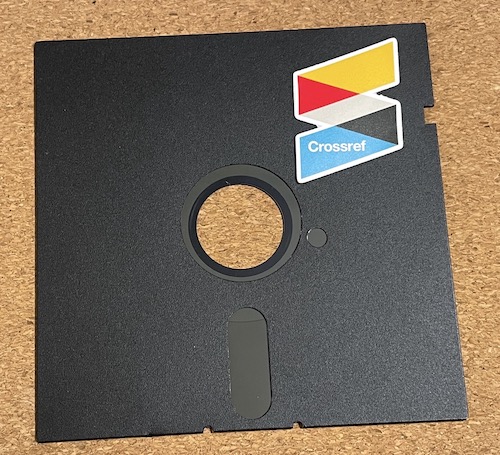
Defence in depth means layers of security and resilience, and that means layers of backups. For some years now, our last line of defence has been a reliable, tried-and-tested technology. One that’s been around for a while. Yes, I’m talking about the humble 5¼ inch floppy disk.
This may come as surprise to some. When things go well, you’re probably never aware of them. In day to day use, the only time a typical Crossref user sees a floppy disk is when they click ‘save’ (yes, some journals still require submissions in Microsoft Word).
History
But why?
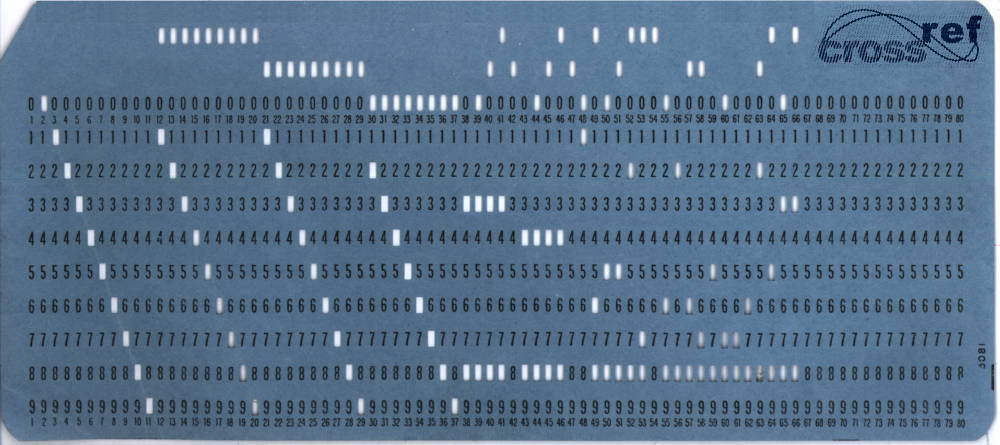
Let me take you back to the early days of Crossref. The technology scene was different. This data was too important to trust to new and unproven technologies like Zip disks, CD-Rs or USB Thumb Drives. So we started with punched cards.
IBM 5081-style punched card.
Punched cards are reliable and durable as long as you don’t fold, spindle or mutilate them. But even in 2001 we knew that punched cards’ days were numbered. The capacity of 80 characters kept DOIs short. Translating DOIs into EBCDIC made ASCII a challenge, let alone SICIs. We kept a close eye on the nascent Unicode.
Breathing Room
In 2017 the change of DOI display guidelines from http://dx.doi.org.ezproxy.galter.northwestern.edu to https://doi-org.ezproxy.galter.northwestern.edu shortened each DOI by 2 characters, buying us some time. But eventually we knew we had to upgrade to something more modern.
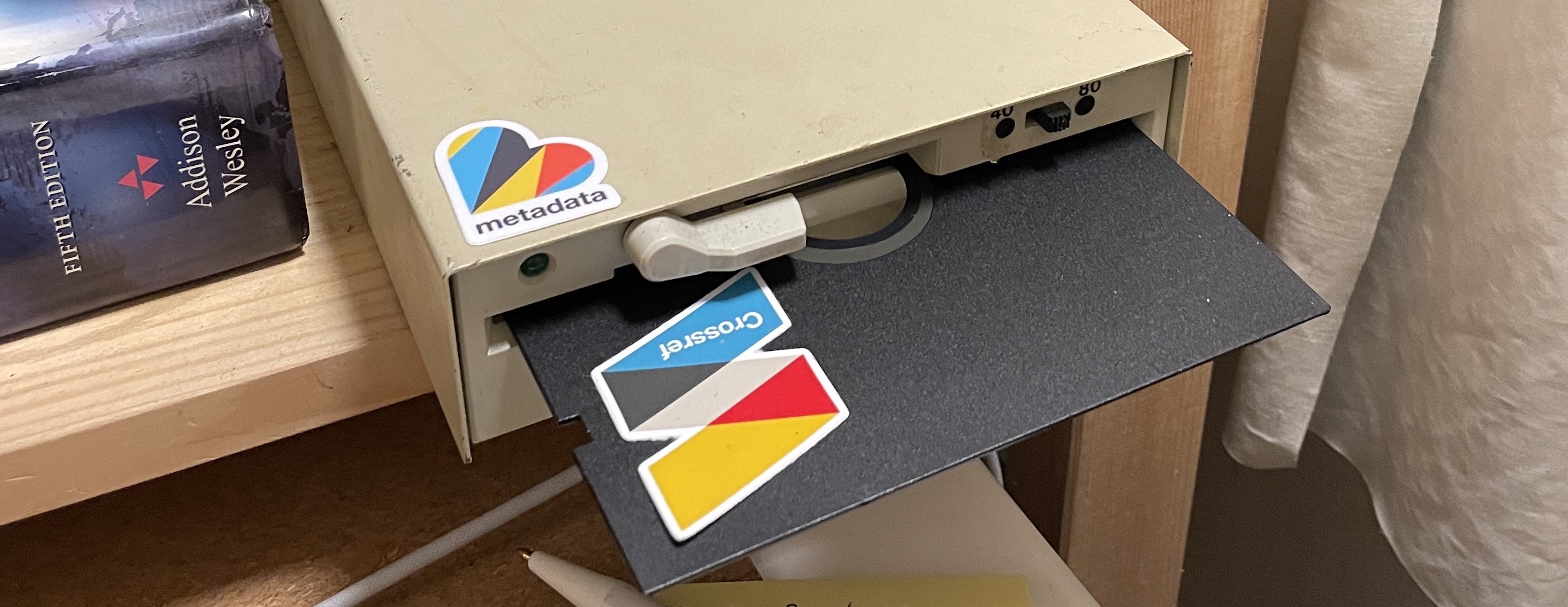
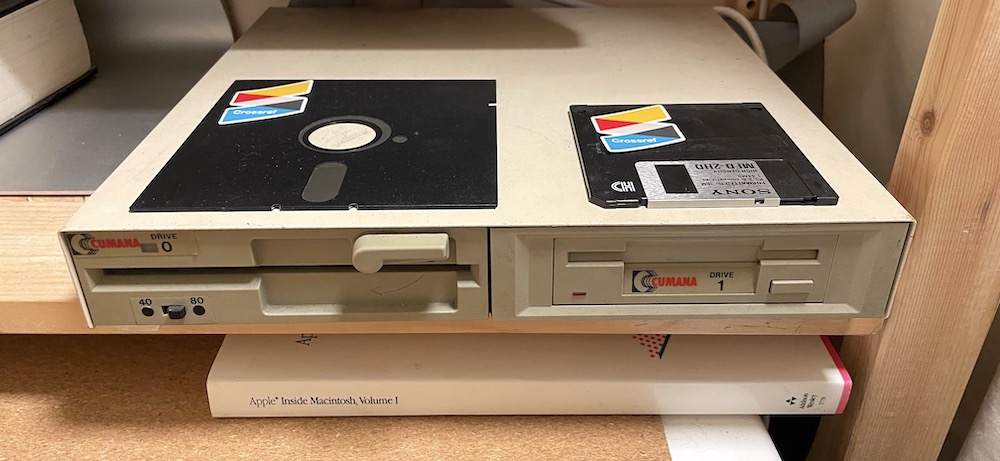
So we migrated to 5¼ inch floppy disks.
5¼ Floppy disk in drive
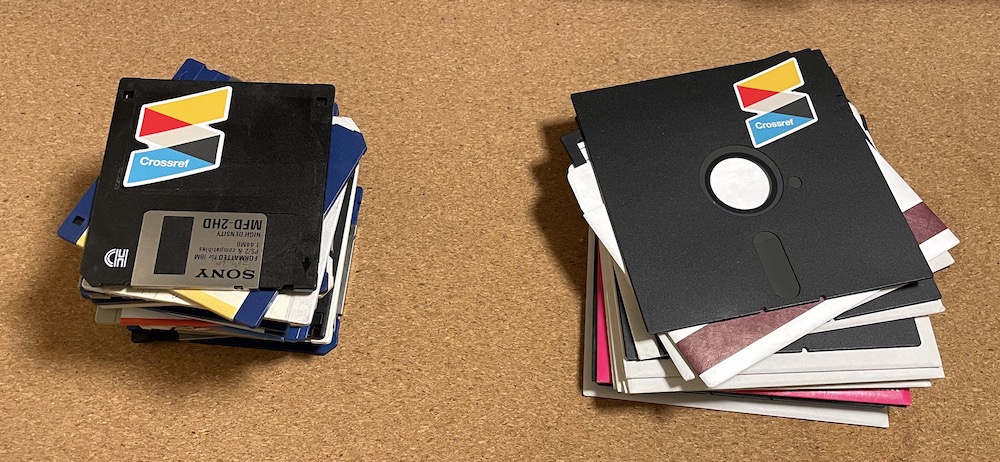
At 640 KB per disk these were a huge improvement. We could fit around 20,000 DOIs on one floppy. Today we only need around 10,000 floppy disks to store all of our DOIs (not the metadata, just the DOIs). Surprisingly this only takes about 20 metres of shelf space to store.
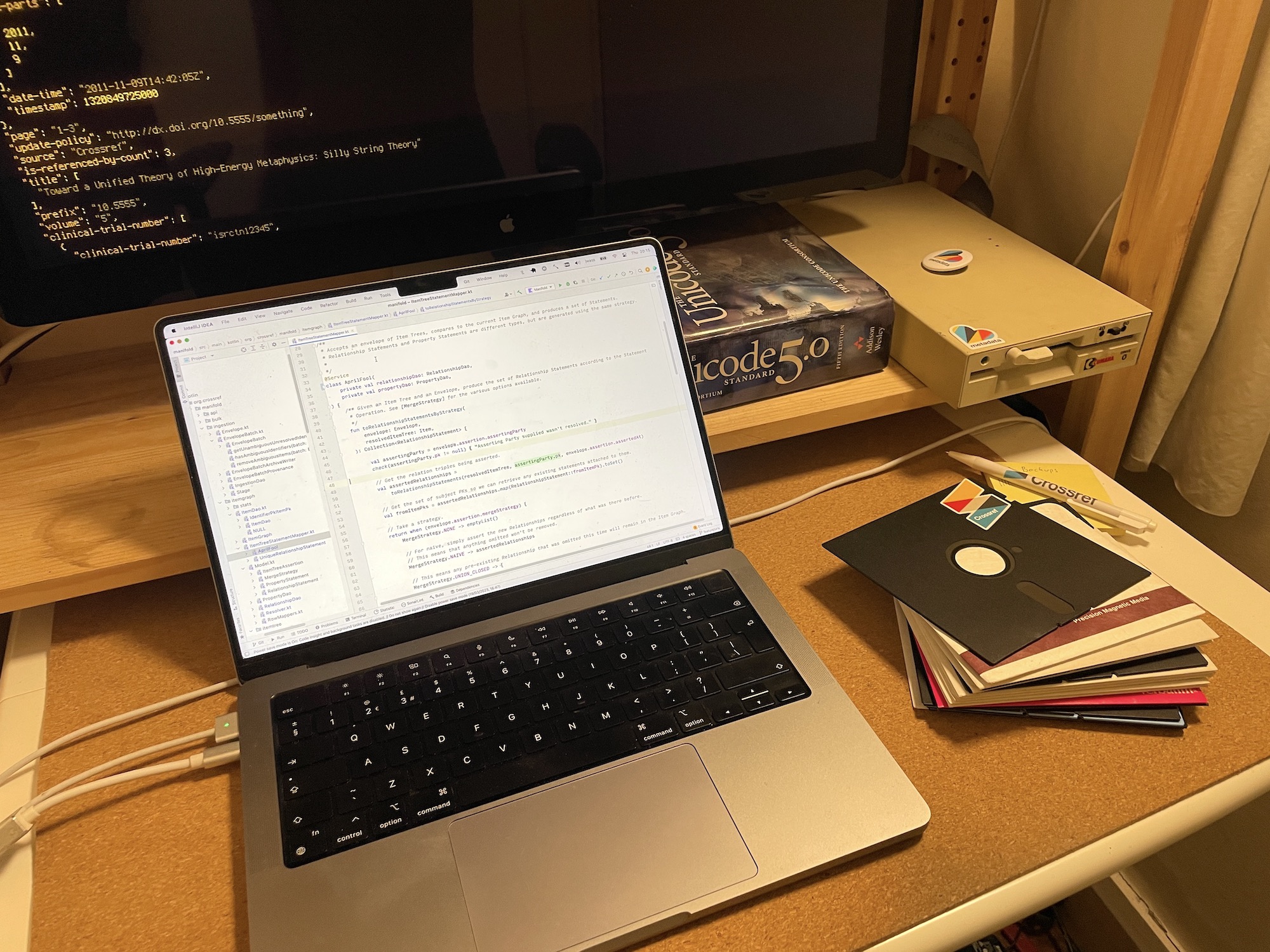
Typical work from home setup. Getting ready to backup some DOIs!
The move to working-from-home brought an unexpected benefit. Staff mail floppy disks to each other and keep them in constant rotation, which produces a distributed fault tolerant system.
Persistence Means Change
But it can’t last forever. DOIs registration shows no sign of slowing down. It’s clear we need a new, compact storage medium. So, after months of research, we’ve invested in new equipment.
Today we announce our migration to 3½ inch floppies.
If it goes to plan you won’t even notice the change.