On behalf of the Nominating Committee, I’m pleased to share the slate of candidates for the 2026 board election. Every active member organisation is invited to submit a ballot to elect the incoming board class.
We’re providing a summary of the board’s July 2026 meeting. The July board meeting is our only in-person meeting. The board gathers for two days of strategic thinking and long-range planning, as well as conducting annual board business. This year, we focused on allocating surplus funds we have on hand to invest in a three-year project to redesign the content system. In a related discussion, we decided to lower content registration fees starting in 2027 because we’ve had a demonstrated history of generating surpluses, exceeding what we need to run Crossref. We also discussed the board structure, as part of our regular review of stakeholder governance. And we conducted annual board business, such as approving the audited financial statements and reviewed our risk register and mitigation plans.
The resolutions are available on the dedicated section of our website, which also lists the members of the Board and offers further information about our governance.
We also managed to squeeze in watching a World Cup game over dinner.
Starting today, funder names deposited in Crossref metadata without an identifier will be matched to ROR IDs, to support an open and connected Research Nexus. Funding information is an increasingly important part of the scholarly record. The improved matching strategy supports researchers, funders, institutions, and meta-researchers, who rely on that information to understand how research is supported and what outcomes that support produces.
Strengthening Scholarly Publishing in Africa is a collaborative webinar series bringing together ASSAf, Crossref, DOAJ, EIFL, and PKP to share practical guidance, resources, and approaches for strengthening the publishing ecosystem in the region. This series responds to the growing interest in open access, digital publishing, stronger editorial practices, and greater visibility of research publishing across Africa. Each partner organisation has long experience of building that capacity in the area of their expertise. In this series, we’re coming together to offer a more holistic learning experience to the community of African publishers, putting different aspects of the publishing process in their broader context.
Crossref acquires Retraction Watch data and opens it for the scientific community
Agreement to combine and publicly distribute data about tens of thousands of retracted research papers, and grow the service together
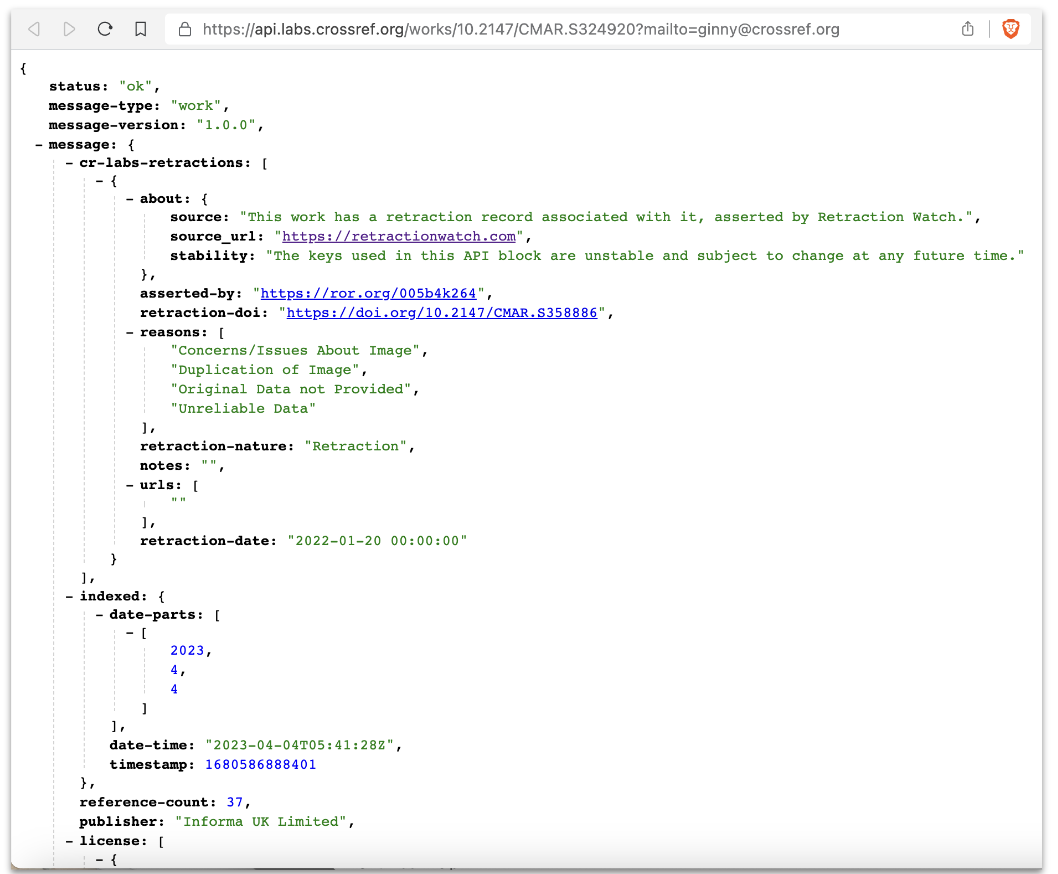
12th September 2023—The Center for Scientific Integrity, the organisation behind the Retraction Watch blog and database, and Crossref, the global infrastructure underpinning research communications, both not-for-profits, announced today that the Retraction Watch database has been acquired by Crossref and made a public resource. An agreement between the two organisations will allow Retraction Watch to keep the data populated on an ongoing basis and always open, alongside publishers registering their retraction notices directly with Crossref.
Both organisations have a shared mission to make it easier to assess the trustworthiness of scholarly outputs. Retractions are an important part of science and scholarship regulating themselves and are a sign that academic publishing is doing its job. But there are more journals and papers than ever, so identifying and tracking retracted papers has become much harder for publishers and readers. That, in turn, makes it difficult for readers and authors to know whether they are reading or citing work that has been retracted. Combining efforts to create the largest single open-source database of retractions reduces duplication, making it more efficient, transparent, and accessible for all.
Product Director Rachael Lammey says, “Crossref is focused on documenting and clarifying the scholarly record in an open and scalable form. For a decade, our members have been recording corrections and retractions through our infrastructure, and incorporating the Crossmark button to alert readers. Collaborating with Retraction Watch augments publisher efforts by filling in critical gaps in our coverage, helps the downstream services that rely on high-quality, open data about retractions, and ultimately directly benefits the research community.”
The Center for Scientific Integrity and the Retraction Watch blog will remain separate from Crossref and will continue their journalistic work investigating retractions and related issues; the agreement with Crossref is confined to the database only and Crossref itself remains a neutral facilitator in efforts to assess the quality of scientific works. Both organisations consider publishers to be the primary stewards of the scholarly record and they are encouraged to continue to add retractions to their Crossref metadata as a priority.
“Retraction Watch has always worked to make our highly comprehensive and accurate retraction data available to as many people as possible. We are deeply grateful to the foundations, individuals, and members of the publishing services industry who have supported our efforts and laid the groundwork for this development,” said Ivan Oransky, executive director of the Center for Scientific Integrity and co-founder of Retraction Watch. “This agreement means that the Retraction Watch Database has sustainable funding to allow its work to continue and improve.”
Please join Crossref and Retraction Watch leadership, among other special guests, for a community call on 27th September at 1 p.m. UTC to discuss this new development in the pursuit of research integrity.
Supporting details
Crossref retractions number 14k, and the Retraction Watch database currently numbers 43k. There is some overlap, making a total of around 50k retractions.
Crossref is paying an initial acquisition fee of USD $175,000 and will pay Retraction Watch USD $120,000 each year, increasing by 5% each year.
The initial term of the contract is five years. The full text of the contract will be made public in the coming fortnight.EDIT 2023-09-26:Here is the signed agreement.
There will be a community call on 27th September at 1 p.m. UTC (your time zone here). Please register.
An open FAQ document is available to collect questions to be answered at the webinar.
About Retraction Watch and The Center for Scientific Integrity
The Center for Scientific Integrity is a U.S. 501(c)3 non-profit whose mission is to promote transparency and integrity in science and scientific publishing, and to disseminate best practices and increase efficiency in science. In addition to maintaining and curating the Retraction Watch Database, the Center is the home of Retraction Watch, a blog founded in 2010 that reports on scholarly retractions and related issues in research integrity.
About Crossref
Crossref is a global community infrastructure that makes all kinds of research objects easy to find, assess, and reuse through a number of services critical to research communications, including an open metadata API that sees over 2 billion queries every month. Crossref’s >19,000 members come from 151 countries and are predominantly university-based. Their ~150 million DOI records contribute to the collective vision of a rich and reusable open network of relationships connecting research organisations, people, things, and actions; a scholarly record that the global community can build on forever, for the benefit of society.