Metadata is communication; it can tell a story about research and paint a picture for others to respond to and learn from, across the world and throughout the forthcoming generations. Metadata can feel technical with words like ‘infrastructure’ and ‘schema’, and sometimes, like tech in general, it comes with hyperbole. But metadata really is part art (storytelling and pictures) and part science (structured models and standards) with both aspects being equally important, and requiring people as well as systems. That necessary combination of human and machine involvement also makes metadata challenging.
Once a year we release all metadata records for content registered with Crossref in a public data file. This year’s version, containing nearly 180 million records, is now available. It includes metadata associated with all Crossref-registered DOIs in JSON-lines format.
Crossref Ambassadors act as local points of contact, meeting editors, librarians, researchers, and institutions to help them navigate Crossref services and understand how strong metadata supports visibility, integrity, and trust in research. They explain how to participate in our rich network of connections between works, people, and institutions, in ways that make sense in their own contexts. And last year, being our 25th anniversary, Ambassadors also massively contributed to our celebrations!
We have renewed our partnership with DOAJ to focus on a new set of objectives that reflect both organisations’ commitment to improving sustainable and equitable services and infrastructure. This renewed collaboration focuses on improving the quality of scholarly metadata while expanding support for journals in low- and middle income- countries.
We have worked together since 2021, primarily to encourage the dissemination and use of scholarly research using online technologies, and regional and international networks, partners and communities. This partnership has helped to build local institutional capacity and sustainability within the global scholarly communication ecosystem. A continued partnership also reflects that we have a shared community; currently almost 90% of DOAJ journals are represented in Crossref.
Crossref acquires Retraction Watch data and opens it for the scientific community
Agreement to combine and publicly distribute data about tens of thousands of retracted research papers, and grow the service together
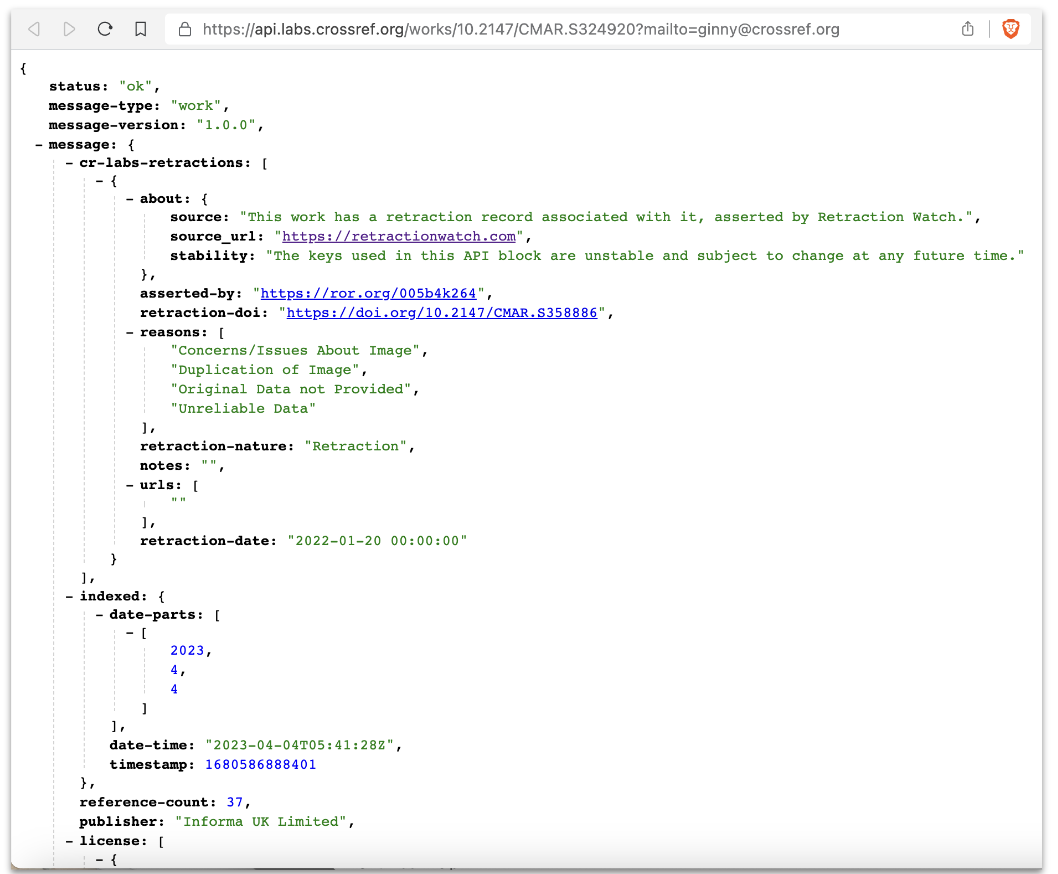
12th September 2023 —– The Center for Scientific Integrity, the organisation behind the Retraction Watch blog and database, and Crossref, the global infrastructure underpinning research communications, both not-for-profits, announced today that the Retraction Watch database has been acquired by Crossref and made a public resource. An agreement between the two organisations will allow Retraction Watch to keep the data populated on an ongoing basis and always open, alongside publishers registering their retraction notices directly with Crossref.
Both organisations have a shared mission to make it easier to assess the trustworthiness of scholarly outputs. Retractions are an important part of science and scholarship regulating themselves and are a sign that academic publishing is doing its job. But there are more journals and papers than ever, so identifying and tracking retracted papers has become much harder for publishers and readers. That, in turn, makes it difficult for readers and authors to know whether they are reading or citing work that has been retracted. Combining efforts to create the largest single open-source database of retractions reduces duplication, making it more efficient, transparent, and accessible for all.
Product Director Rachael Lammey says, “Crossref is focused on documenting and clarifying the scholarly record in an open and scalable form. For a decade, our members have been recording corrections and retractions through our infrastructure, and incorporating the Crossmark button to alert readers. Collaborating with Retraction Watch augments publisher efforts by filling in critical gaps in our coverage, helps the downstream services that rely on high-quality, open data about retractions, and ultimately directly benefits the research community.”
The Center for Scientific Integrity and the Retraction Watch blog will remain separate from Crossref and will continue their journalistic work investigating retractions and related issues; the agreement with Crossref is confined to the database only and Crossref itself remains a neutral facilitator in efforts to assess the quality of scientific works. Both organisations consider publishers to be the primary stewards of the scholarly record and they are encouraged to continue to add retractions to their Crossref metadata as a priority.
“Retraction Watch has always worked to make our highly comprehensive and accurate retraction data available to as many people as possible. We are deeply grateful to the foundations, individuals, and members of the publishing services industry who have supported our efforts and laid the groundwork for this development,” said Ivan Oransky, executive director of the Center for Scientific Integrity and co-founder of Retraction Watch. “This agreement means that the Retraction Watch Database has sustainable funding to allow its work to continue and improve.”
Please join Crossref and Retraction Watch leadership, among other special guests, for a community call on 27th September at 1 p.m. UTC to discuss this new development in the pursuit of research integrity.
Supporting details
Crossref retractions number 14k, and the Retraction Watch database currently numbers 43k. There is some overlap, making a total of around 50k retractions.
Crossref is paying an initial acquisition fee of USD $175,000 and will pay Retraction Watch USD $120,000 each year, increasing by 5% each year.
The initial term of the contract is five years. The full text of the contract will be made public in the coming fortnight.EDIT 2023-09-26:Here is the signed agreement.
There will be a community call on 27th September at 1 p.m. UTC (your time zone here). Please register.
An open FAQ document is available to collect questions to be answered at the webinar.
About Retraction Watch and The Center for Scientific Integrity
The Center for Scientific Integrity is a U.S. 501(c)3 non-profit whose mission is to promote transparency and integrity in science and scientific publishing, and to disseminate best practices and increase efficiency in science. In addition to maintaining and curating the Retraction Watch Database, the Center is the home of Retraction Watch, a blog founded in 2010 that reports on scholarly retractions and related issues in research integrity.
About Crossref
Crossref is a global community infrastructure that makes all kinds of research objects easy to find, assess, and reuse through a number of services critical to research communications, including an open metadata API that sees over 2 billion queries every month. Crossref’s >19,000 members come from 151 countries and are predominantly university-based. Their ~150 million DOI records contribute to the collective vision of a rich and reusable open network of relationships connecting research organisations, people, things, and actions; a scholarly record that the global community can build on forever, for the benefit of society.