We’re providing a summary of the board’s July 2026 meeting. The July board meeting is our only in-person meeting. The board gathers for two days of strategic thinking and long-range planning, as well as conducting annual board business. This year, we focused on allocating surplus funds we have on hand to invest in a three-year project to redesign the content system. In a related discussion, we decided to lower content registration fees starting in 2027 because we’ve had a demonstrated history of generating surpluses, exceeding what we need to run Crossref. We also discussed the board structure, as part of our regular review of stakeholder governance. And we conducted annual board business, such as approving the audited financial statements and reviewed our risk register and mitigation plans.
The resolutions are available on the dedicated section of our website, which also lists the members of the Board and offers further information about our governance.
We also managed to squeeze in watching a World Cup game over dinner.
Starting today, funder names deposited in Crossref metadata without an identifier will be matched to ROR IDs, to support an open and connected Research Nexus. Funding information is an increasingly important part of the scholarly record. The improved matching strategy supports researchers, funders, institutions, and meta-researchers, who rely on that information to understand how research is supported and what outcomes that support produces.
Strengthening Scholarly Publishing in Africa is a collaborative webinar series bringing together ASSAf, Crossref, DOAJ, EIFL, and PKP to share practical guidance, resources, and approaches for strengthening the publishing ecosystem in the region. This series responds to the growing interest in open access, digital publishing, stronger editorial practices, and greater visibility of research publishing across Africa. Each partner organisation has long experience of building that capacity in the area of their expertise. In this series, we’re coming together to offer a more holistic learning experience to the community of African publishers, putting different aspects of the publishing process in their broader context.
We’ve had a year full of growth and reached a milestone of 60+ team members; let’s take a moment to digest what that means for people operations. Hiring staff in 19+ countries is no easy task, but we are up for it, and I can honestly say it is the main reason why our culture is so great. That might sound biased coming from Crossref’s first Head of Human Resources, but hear me out.
Just when you thought 2020 couldn’t go any faster, it’s Peer Review week again! Peer Review is such an important part of the research process and highlighting the role it plays is key to retaining and reinforcing trust in the publishing process.
“Maintaining trust in the peer review decision-making process is paramount if we are to solve the world’s most pressing problems. This includes ensuring that the peer review process is transparent (easily discoverable, accessible, and understandable by anyone writing, reviewing, or reading peer-reviewed content) and that everyone involved in the process receives the training and education needed to play their part in making it reliable and trustworthy.”
A key way that publishers can make peer reviews easily discoverable and accessible is by registering them with Crossref - creating a persistent identifier for each review, linking them to the relevant article, and providing rich metadata to show what part this item played in the evolution of the content. It also gives a way to acknowledge the incredible work done by academics in this area.
For Peer Review week last year, Rosa and Rachael from Crossref created this short video to explain more.
Fast forward to 2020 and over 75k peer reviews have now been registered with us by a range of members including Wiley, Peer J, eLife, Stichting SciPost, Emerald, IOP Publishing, Publons, The Royal Society and Copernicus. We encourage all members to register peer reviews with us - and you can keep up to date with everyone who is using this API query. (We recommend installing a JSON viewer for your browser to view these results if you haven’t done so already).
Register peer reviews and contribute to the Research Nexus
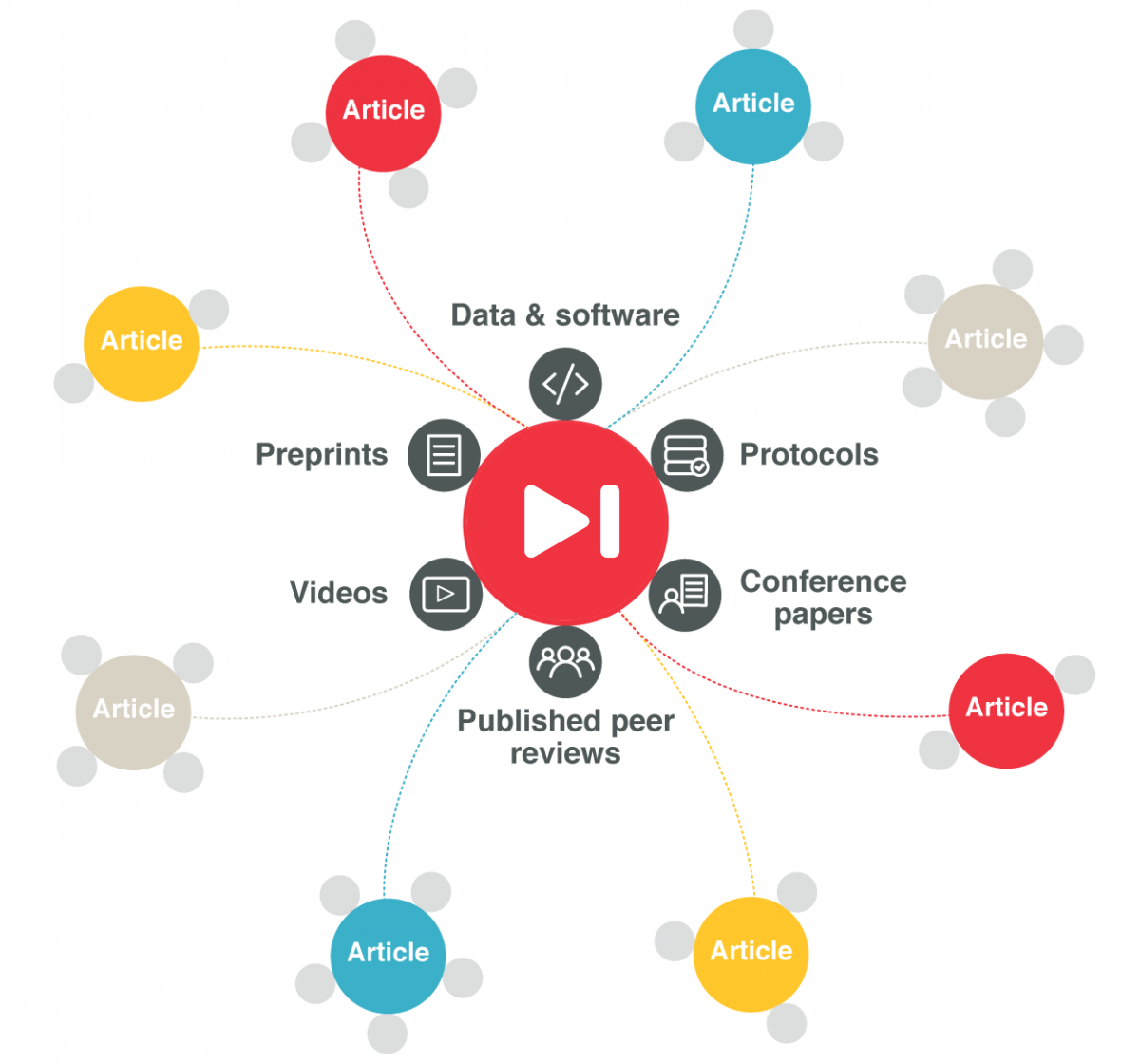
At Crossref, we talk a lot about the research nexus, and it’s a theme that you’re going to hear a lot more about from us in the coming months and years.
The published article no longer has the supremacy it once did, and other outputs - and inputs - have increasing importance. Linked data and protocols are key for reproducibility, peer reviews increase trust and show the evolution of knowledge, and other research objects help increase the discoverability of content. Registering these objects and stating the relationships between them support the research nexus.
Peer reviews in particular are key to demonstrating that the scholarly record is not fixed - it’s a living entity that moves and changes over time. Registering peer reviews formally integrates these objects into the scholarly record and makes sure the links between the reviews and the article both exist and persist over time. It allows analysis or research on peer reviews and highlights richer discussions than those provided by the article alone, showing how discussion and conversation help to evolve knowledge. In particular, post-publication reviews highlight how the article is no longer the endpoint - after publication, research is further validated (or not!) and new ideas emerge and build on each other. You can see a real-life example of this from F1000 in a blog post written by Jennifer Lin a few years ago.
As we’ve said before:
Article metadata + peer review metadata = a fuller picture of the evolution of knowledge
Registering peer reviews also provides publishing transparency and reviewer accountability, and enables contributors to get credit for their work. If peer review metadata includes ORCID IDs, our ORCID auto-update service means that we can automatically update the author’s ORCID record (with their permission), while our forthcoming schema update will take this even further, making CRediT roles available in our schema.
How to register peer reviews with Crossref
You need to be a member of Crossref in order to register your peer reviews with us and you can currently register peer reviews by sending us your XML files. Unfortunately, you can’t currently register peer reviews using our helper tools like the OJS plugin, Metadata Manager, or the web deposit form.
We know that there’s a range of outputs from the peer review process, and our schema allows you to identify many of them, including referee reports, decision letters, and author responses. You can include outputs from the initial submission only, or cover all subsequent rounds of revisions, giving a really clear picture of the evolution of the article. Members can even register content for discussions after the article was published, such as post-publication reviews.
Get involved with Peer Review Week 2020
We’re looking forward to seeing the debate sparked by Peer Review Week and hearing from our members about this important area. You can get involved by checking out the Peer Review Week 2020 website or following @PeerRevWeek and the hashtags #PeerRevWk20 #trustinpeerreview on Twitter.
We’re excited to see what examples of the evolution of knowledge will be discoverable in registered and linked peer reviews this time next year!