On behalf of the Nominating Committee, I’m pleased to share the slate of candidates for the 2026 board election. Every active member organisation is invited to submit a ballot to elect the incoming board class.
We’re providing a summary of the board’s July 2026 meeting. The July board meeting is our only in-person meeting. The board gathers for two days of strategic thinking and long-range planning, as well as conducting annual board business. This year, we focused on allocating surplus funds we have on hand to invest in a three-year project to redesign the content system. In a related discussion, we decided to lower content registration fees starting in 2027 because we’ve had a demonstrated history of generating surpluses, exceeding what we need to run Crossref. We also discussed the board structure, as part of our regular review of stakeholder governance. And we conducted annual board business, such as approving the audited financial statements and reviewed our risk register and mitigation plans.
The resolutions are available on the dedicated section of our website, which also lists the members of the Board and offers further information about our governance.
We also managed to squeeze in watching a World Cup game over dinner.
Starting today, funder names deposited in Crossref metadata without an identifier will be matched to ROR IDs, to support an open and connected Research Nexus. Funding information is an increasingly important part of the scholarly record. The improved matching strategy supports researchers, funders, institutions, and meta-researchers, who rely on that information to understand how research is supported and what outcomes that support produces.
Strengthening Scholarly Publishing in Africa is a collaborative webinar series bringing together ASSAf, Crossref, DOAJ, EIFL, and PKP to share practical guidance, resources, and approaches for strengthening the publishing ecosystem in the region. This series responds to the growing interest in open access, digital publishing, stronger editorial practices, and greater visibility of research publishing across Africa. Each partner organisation has long experience of building that capacity in the area of their expertise. In this series, we’re coming together to offer a more holistic learning experience to the community of African publishers, putting different aspects of the publishing process in their broader context.
Test out the early preview of Event Data while we continue to develop it. Share your thoughts. And be warned: we may break a few eggs from time to time!
Chicken by anbileru adaleru from the The Noun Project
Want to discover which research works are being shared, liked and commented on? What about the number of times a scholarly item is referenced? Starting today, you can whet your appetite with an early preview of the forthcoming Crossref Event Data service. We invite you to start exploring the activity of DOIs as they permeate and interact with the world after publication.
But first, a bit of background
Discussion around scholarly research increasingly occurs online after publication, for example on blogs, sharing services, social media, and wikis. These ‘events’ occur across the web on numerous platforms and are a critical part of the scholarly enterprise. We are developing an infrastructure service (Crossref Event Data) that collects, stores, and delivers raw data of the events occurring with Crossref DOIs. We will store the data in an open, auditable and portable form for the community to access. Publishers, platforms, funders, bibliometricians and service providers may benefit from access to this raw data, and it can be used to feed into research records or proprietary tools and services that offer aggregation and analysis.
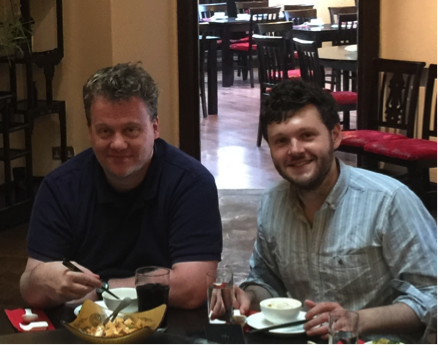
Developers Martin Fenner (DataCite) and Joe Wass (Crossref) enjoy a tofu break
Lagotto, the software originally developed at PLOS, has been extended and improved in a joint effort between DataCite and Crossref. The two DOI Registration Agencies have partnered to envision, build and release the service. On the 13th of April, after a year ofcollaboration, we jointly released Lagotto 5.0. You can read about the collaboration on the DataCite blog post.
Crossref and DataCite will continue to work closely together to develop Lagotto and the Event Data service. Although Crossref Event Data has mostly Crossref DOIs at launch, you will be able to find DataCite DOIs if they are cited in Crossref or Wikipedia.
All of the software that runs Event Data, including Lagotto, is developed in the open and is open source. Please refer to the Crossref Event Data Technical User Guide for full details.
Preview the data
This service is currently under development with a full launch expected the second half of 2016. Before it is launched however, we invite you to take a look around and preview a subset of the data sources we plan to include. You may experience occasional hiccups while we continue building the service.
At this stage, we are working with data from three sources although we will greatly expand the variety of platforms from which we collect data as development progresses. At this stage, you can view Mendeley bookmarks, Wikipedia references, and Crossref to DataCite links.
Mendeley
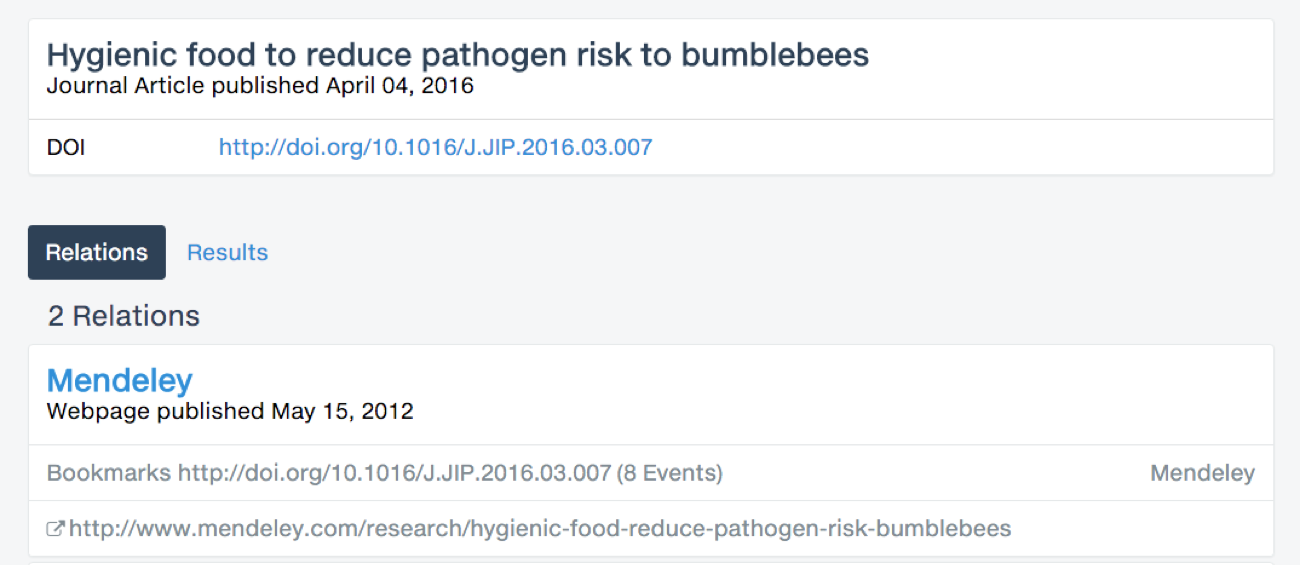
Mendeley is a reference manager and academic social network for scholars. View the number of social bookmarks from scholars or groups on Mendeley.
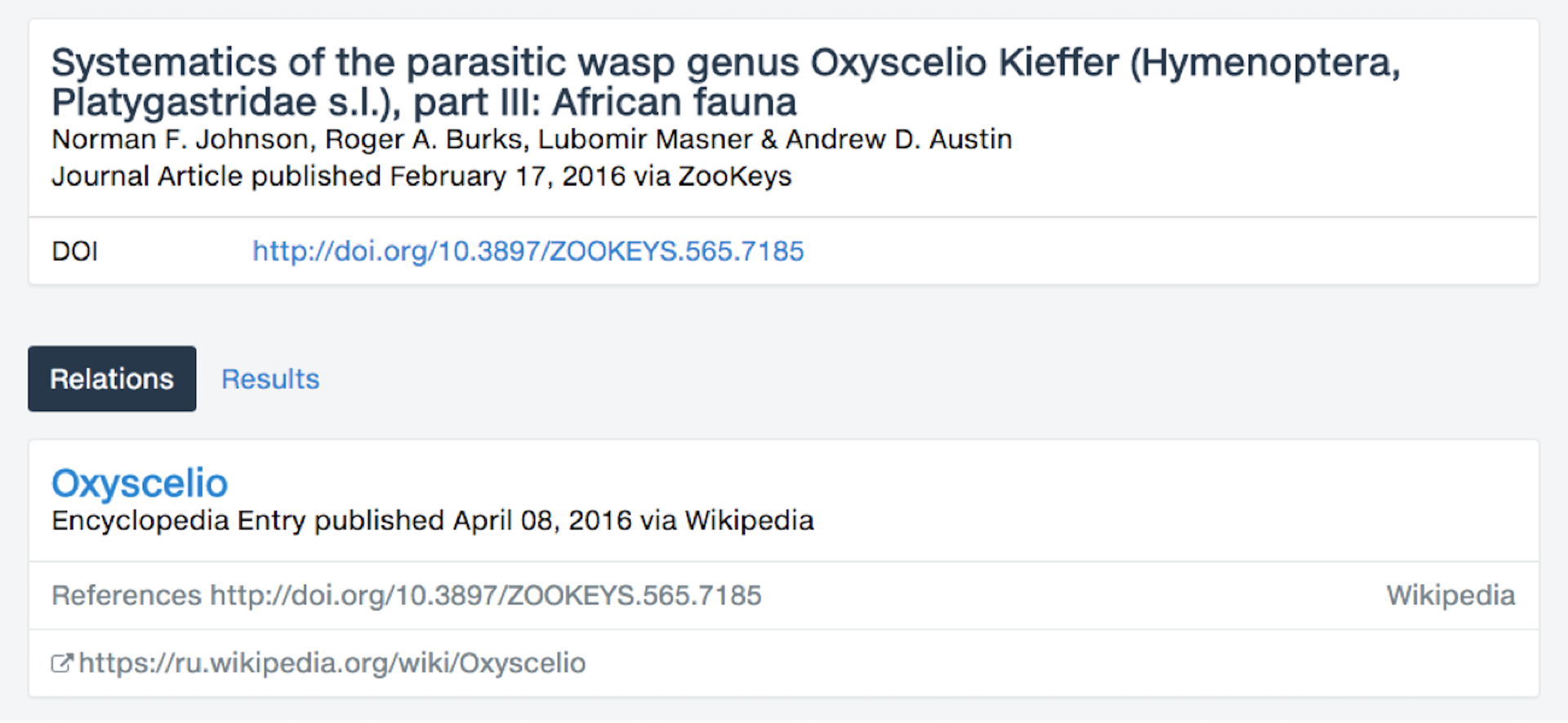
Wikipedia is an online encyclopaedia, the Internet’s largest and most popular general reference work. View references in Wikipedia of Crossref publications in Wikipedia articles in all languages.
DataCite is a global consortium that assigns DOIs to research data. This enables people to find, share, use, and cite data. You can view all the data citations to DataCite research outputs found in Crossref publications (work is underway to make the links found in DataCite metadata available in Event Data).
This service is currently under development and as such we welcome your thoughts and feedback on the data we are collecting currently from our three active sources. As a reminder, we expect to include the following sources as part of our full service launch later this year (pending confirmation):
[table id=1 /]
We’re also on the lookout for new data sources to investigate for future inclusion in the Event Data service so please do get in touch with requests and recommendations. As we continue to build the service throughout 2016, we will be committing to a model of continuous development so that we can make new sources available as they are completed.
Watch this blog for regular updates on our progress, or subscribe to receive new blog posts by email (just add your details to the upper right side of this page).